 See a sample QuestDash
Every major AI model ships with a scorecard. Before anyone puts it to work, it has taken the same public tests as its rivals, and anyone can see where it ranks.
The team that puts that model to work gets a pulse survey, and a look at the numbers after the quarter closes. We measure the tools far better than the people using them. As teams get smaller and agents take on more of the work, that mismatch gets expensive.
Teams Are Getting Smaller
In 2025, Shopify's CEO told his company that before anyone asks for more people, they have to show why AI can't do the job. Plenty of companies now run on the same rule without writing it down.
The companies built this way already look different. Lovable passed $100 million in annual recurring revenue eight months after launch with 45 employees. That works out to about $2.2 million per person, roughly 15 times what a typical private software company brings in per employee. Most companies won't hit those numbers. Boards have seen them anyway, and next year's plans assume more output per person.
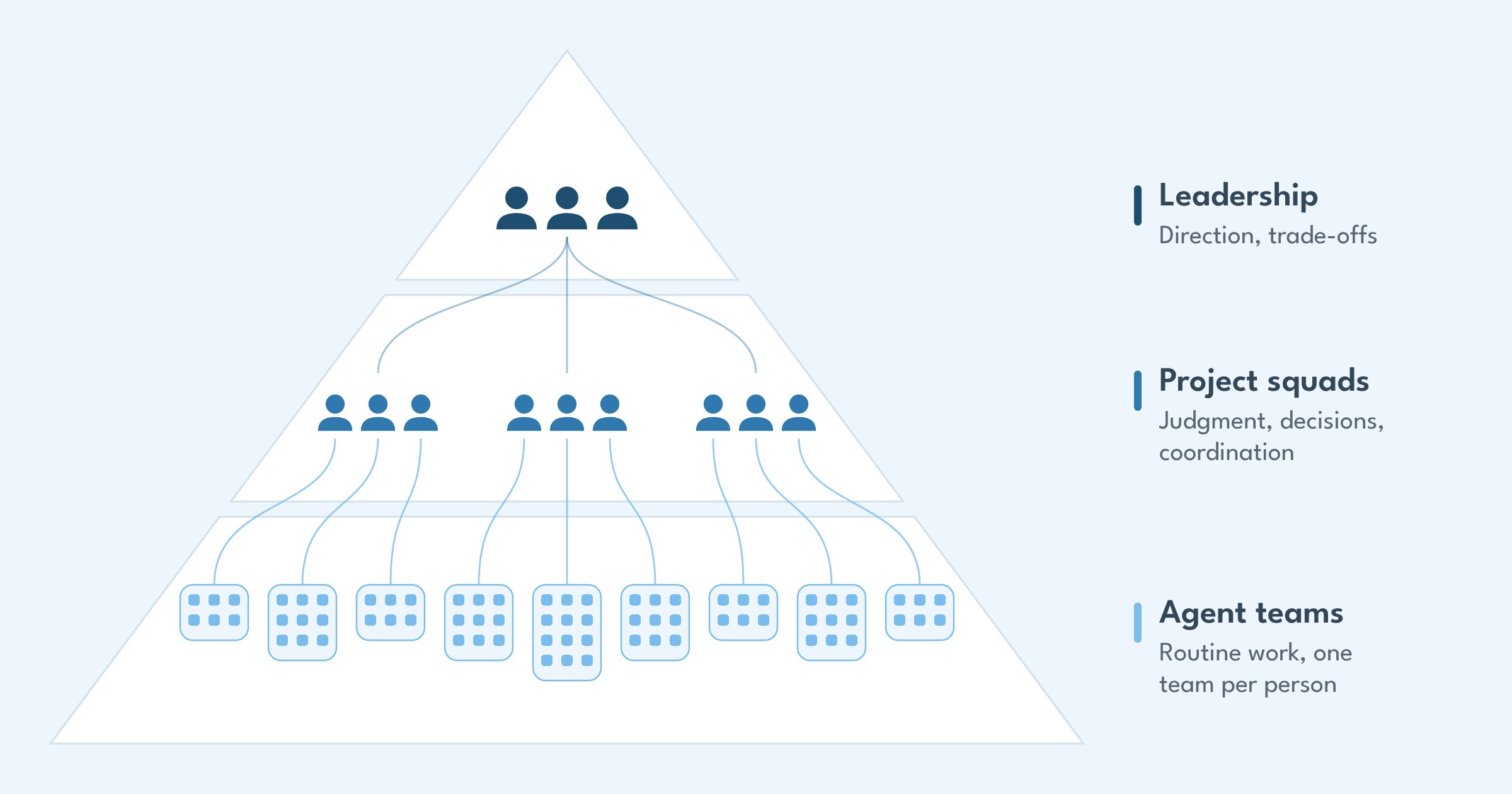
The pyramid above is where this leads. A small leadership team sets direction. Under it sit three project squads of three people, and under each person sits a team of agents. Within a few years, one person directing five to twenty agents will be ordinary. Headcount stays small, and the expectations per person keep climbing.
Agents Take the Routine Work
Agents are getting good at anything you can fully specify: drafting, coding to a spec, research, reconciling data, first-pass analysis. That work used to fill most of a junior employee's day.
What's left for people is the work you can't hand off in a prompt: deciding what is good enough to ship, choosing between two options when the evidence points both ways, and keeping five people and fifty agents aimed at the same outcome. Judgment, decisions and coordination are the job now.
More of each person's day goes to directing the work, reviewing it and deciding what ships. When everyone on a team directs agents, the team's results come down to how well those people decide together.
Everyone Is Siloed With Their AI
A person with a stack of agents can do in an afternoon what used to take a team a week, and they can do it without talking to anyone. Most people take that deal.
The quick question to a teammate disappears. So does the hallway "wait, we changed that," which used to catch a mistake before it shipped. Each person moves fast in their own direction, and the team finds out it has drifted when the pieces don't fit.
You have probably seen it already: the polished deck built on last month's assumptions, the feature nobody asked for, the AI-written doc that took five minutes to make and an hour to fix. Individual speed went up while alignment stayed where it was.
Teams Form and Dissolve by Project
A twelve-person company can't keep a standing team for every function, so people go where the work is. A squad comes together for a launch, ships it, and splits up for the next thing.
That is efficient, and it cuts out the months teams used to spend figuring each other out. Nobody gets half a year to learn who decides fast, who spots the flaw and who goes silent under pressure. The squad needs to know all of that on day one.
Aviation learned what unfamiliar crews cost. An NTSB study of major U.S. airline accidents found that 11 of the 15 it could analyze happened on the crew's first day flying together. The future of teams is full of first days.
Culture Loses Influence and Chemistry Gains It
Culture works at the scale of a company. It tells thousands of people how decisions get escalated and what gets celebrated. It does very little for three people who need to make a hard call by Thursday.
A squad runs on chemistry: how fast those three people make a decision, whether the hard thing gets said in the room, and whether the same argument keeps coming back. Chemistry has nothing to do with liking each other. Plenty of friendly teams still send every decision up to the manager.
So assign people to a squad's decisions and coordination by competence and fit, and look past title and seniority. Research on group intelligence points the same way: how a group works together predicts its collective intelligence better than how skilled each member is. In a small squad, every remaining seat is a bet on fit.
AI Gets Benchmarks and Teams Get Surveys
We measure models carefully. The major ones all take the same public tests, the results are compared to the decimal, and progress is tracked year to year. On one coding benchmark, top scores went from 60% to near 100% in a single year. Before you deploy a model, you have a good idea how it will do.
We measure the team that uses those models with two tools. The engagement survey asks people how they feel. The quarterly review reads the results once the quarter is over. One is self-reported, and the other arrives too late to change that quarter.
Self-reports are shaky even from experts. In a 2025 study, experienced developers using AI tools took 19% longer on their tasks and still believed AI had made them 20% faster. If skilled people misjudge their own speed that badly, a survey asking a team how well it decides under pressure is guesswork.
The Team Needs a Benchmark of Its Own
The team, the unit that combines people and their agents, is where the work succeeds or fails. It deserves a measure as good as the one we give the models, and that measure has three requirements.
- Objective. It reads what the team does, so nobody has to rate themselves.
- Comparable. Every team sits on the same scale, so a leader can set the product squad beside the finance squad the way a lab compares two models.
- Forward-looking. It reads a team before the work counts, while there is still time to act on it.
That benchmark is Team Intelligence™. It has two pillars. Identity is what a team knows about itself: its strengths, its habits and how it acts under pressure. Instinct is what the team does with that knowledge without being told. A team with strong Identity knows its fastest decider tends to talk over its quietest member. A team with strong Instinct makes room for that person before anyone has to say so.
Where QuestWorks Fits
QuestWorks is built to give that reading. A team plays a 25-minute, voice-controlled quest together. The story is fiction, so people act like themselves, and because the game belongs to nobody's job, a sales squad and an engineering squad land on the same scale. The result is a Team Intelligence™ Score from 0 to 100, read from how the team plays.
Today the score reads teams of people. Scoring teams of people and agents together, and comparing teams across companies, is where it is going. The squads that will lead those agents can get their first reading now.